An extra spoonful may not seem like much. Neither does an additional squeeze of mayonnaise, barbecue sauce or ketchup. But when that small extra amount is repeated dozens or hundreds of times every day, it becomes a very different issue.
Sauce portion control is one of those operational details that can easily go unnoticed in a restaurant kitchen, at the pass, or when preparing takeaway and delivery orders. Yet it has a direct impact on the actual cost of every dish you sell.
Ketchup, mayonnaise, aioli, barbecue sauce, cheese sauce, guacamole, dressings and homemade sauces all have a cost. If your recipe costing assumes one quantity but your team consistently serves another, the real food cost of the dish no longer matches the figure you originally calculated.
The aim is not to give customers less or reduce the quality of their experience. It is to ensure that each order leaves the kitchen with the amount of sauce your business has deliberately decided is appropriate.
That is the difference between a generous portion and an uncontrolled portion.
Sauce is part of the cost of the dish too
When calculating the cost of a burger, portion of chips, poke bowl, wrap or delivery meal, most of the attention naturally goes to the main ingredients.
Meat, bread, cheese and vegetables are often carefully weighed and costed.
Sauces are much more likely to be added by eye.
But sauce is still part of the food cost of the dish.
If your specification calls for 30 ml of sauce and each member of staff serves what they think looks right, one portion may contain 25 ml, another 35 ml and another 45 ml.
The problem is not simply those extra millilitres.
The bigger issue is that you lose an accurate picture of how much each dish actually costs to produce.
A small difference becomes significant when it is repeated
Imagine a sauce that costs your business £6 per litre.
The calculation is straightforward:
Cost per portion = cost per litre ÷ 1,000 × millilitres served
A planned 30 ml serving costs £0.18.
If the real average serving is 45 ml, the cost increases to £0.27.
That is only 9p more per order.
But multiply that difference by 100 or 200 orders a day, and then by every trading day in a month.
It is no longer such a small amount.
Controlling sauce portions is therefore not about obsessing over every drop. It is about preventing small, recurring variations from gradually eating into your margin without necessarily adding extra value for the customer.
First, decide how much sauce you actually want to serve
You cannot control a portion if nobody has defined what that portion should be.
“A bit of sauce”, “a generous squeeze”, “one spoonful” or “fill the pot roughly to here” may be understandable instructions, but they do not provide a reliable standard for a professional operation.
Set a quantity for each sauce and each use
Not every sauce needs the same portion size.
The amount of aioli served with chips does not necessarily need to match the amount of salsa for nachos, dressing for a salad or sauce for a burger.
Before choosing a dispensing system, define how many grams or millilitres each application genuinely requires.
For example, your business might establish one standard for:
- chips;
- chicken bites;
- burgers;
- salads;
- loaded fries;
- sauces sold separately as extras.
The important thing is not for every portion to be the same.
The important thing is for each use to have its own clear standard.
Include sauces in your recipe costing
If your business works with recipe sheets or dish costings, sauces should be included in exactly the same way as every other ingredient.
Rather than simply writing:
barbecue sauce
use something more precise:
barbecue sauce – 30 ml – £0.18
You can then compare:
planned portion → planned cost → actual portion → actual cost.
If a regular difference appears, it becomes much easier to identify where margin is being lost.


The problem with serving sauce by eye
Most excess sauce is not served because members of staff deliberately want to waste product.
It usually happens because there is no precise standard.
One employee squeezes the bottle for one second.
Another does it for two.
One person fills a sauce pot three-quarters full.
Another fills it to the top because they think it looks more generous.
Each decision may seem reasonable in isolation.
The problem appears when a restaurant adds together hundreds of slightly different decisions every day.
Lack of consistency also affects the customer
Portion control is not just about saving money.
It also helps create a more consistent product.
A customer who orders the same burger or meal twice expects roughly the same experience.
If they receive plenty of sauce one day and barely enough the next, their perception of the product may change even though everything else is identical.
Standardisation allows the business to decide what it considers the right portion and reproduce that amount regardless of who is working that shift.
How to control sauce portions without slowing down service
A good portion-control system should not turn the kitchen pass into a laboratory.
If every sauce needs to be weighed, measured and transferred through several different steps, staff are unlikely to maintain the process during the busiest periods.
The system needs to be quick, repeatable and easy to understand.
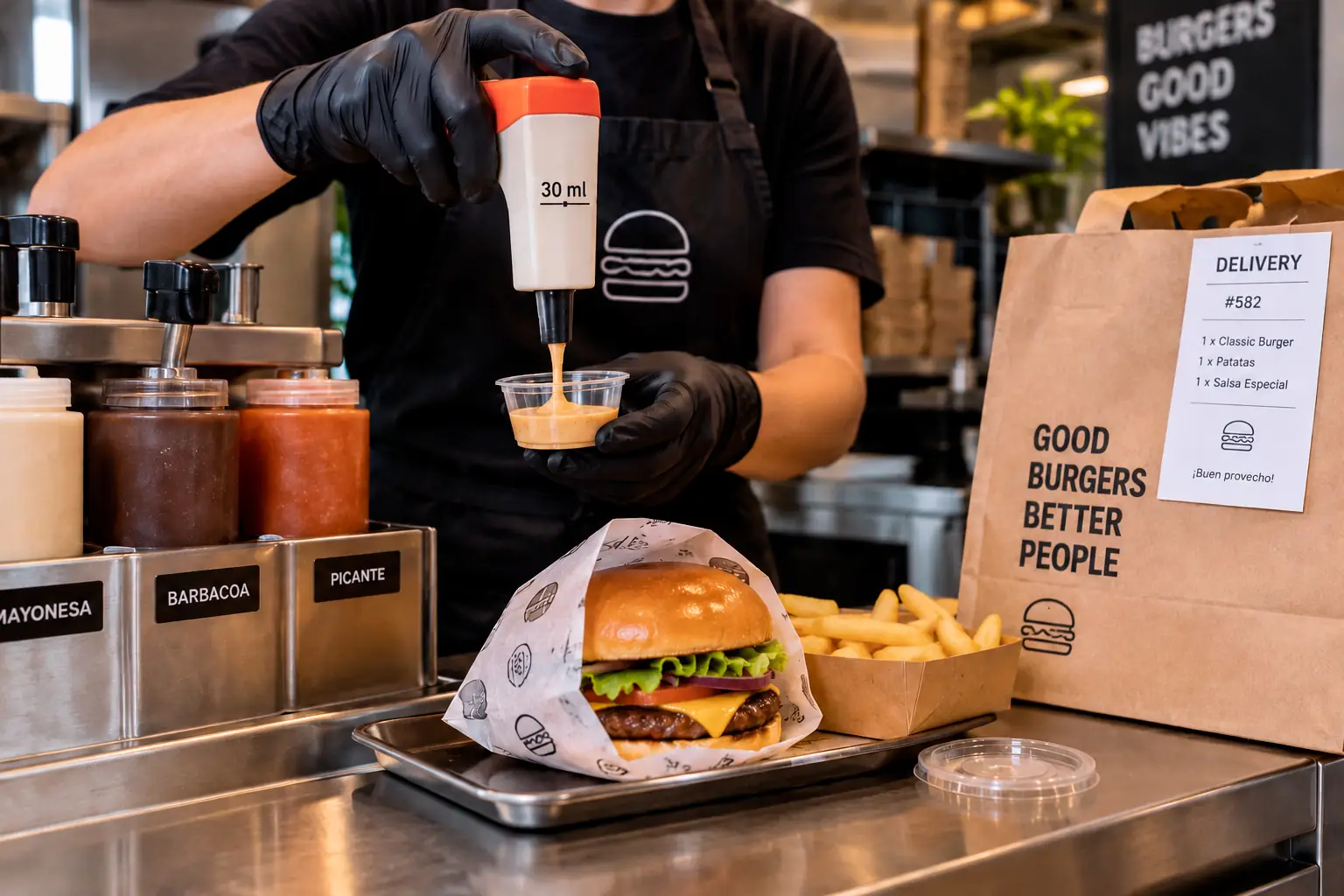
Use dispensers with a known portion
For sauces applied directly to dishes, a standardised dispenser can help create much more consistent servings.
The important thing is to know how much product is released with each pump or portion.
Instead of a recipe simply saying:
“Add sauce”
it can specify a repeatable measurement, such as one measured dispense or a defined number of millilitres.
This can work especially well in burger restaurants, quick-service restaurants, sandwich shops, food trucks and other businesses preparing high volumes of the same dishes.
Match the sauce pot to the required portion
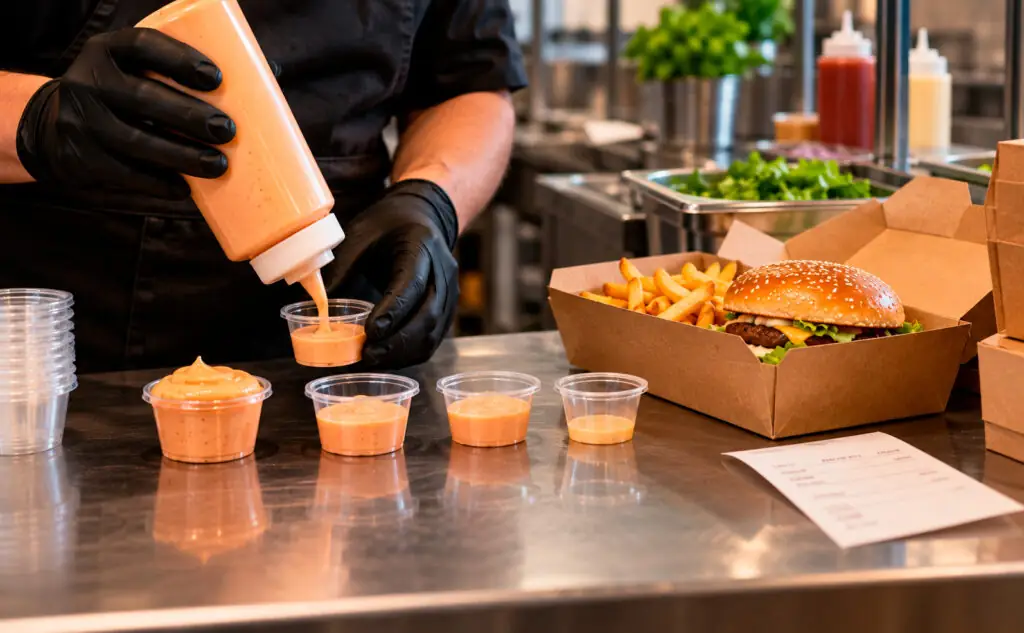
For takeaway and delivery, the size of the sauce container itself can help with portion control.
If one dip is always served in the same small container, staff already have a strong visual reference when filling it.
The packaging becomes part of the portioning system.
Different sauces may require different capacities depending on whether they are a small accompaniment, part of a larger sharing order or sold as an additional extra.
The goal is to select a container that reflects the intended serving rather than automatically using an oversized pot for every sauce.
Do not confuse container capacity with portion size
A 60 ml sauce pot does not necessarily mean you need to fill it with 60 ml of sauce.
You might deliberately use 45 or 50 ml to leave enough headspace for secure closing, easier handling and cleaner transport.
The key is to define the amount.
If the agreed portion is 45 ml, it should be approximately 45 ml regardless of which member of staff prepares the order.


Delivery is where giving away extra sauce becomes particularly easy
In a restaurant, customers can ask for more sauce if they need it.
Delivery changes the dynamic.
Staff may worry that the order will feel incomplete and add an extra pot, overfill the container or include sauces that were not actually requested.
It may feel like better service.
But there is an important question to ask:
Does the customer genuinely value that additional amount, or are you simply increasing the cost of the order?
Separate included sauces from paid extras
It can be useful to define exactly what each menu item includes.
For example, a burger meal could include one sauce as standard, with any additional sauces available as paid extras.
The customer knows what they will receive and the business can cost the order properly.
An extra sauce stops being an automatic giveaway and becomes a deliberate option within your menu.
This can be especially relevant for burger restaurants, fast-food outlets, kebab shops, fried chicken businesses, Asian food concepts and any operation with high volumes of dips and condiments.
Identify which sauces are creating the biggest cost variations
Not every sauce requires the same level of attention.
A low-cost sauce served occasionally may have relatively little financial impact. A homemade sauce containing avocado, cheese, nuts, premium oils or other higher-cost ingredients may matter considerably more.
Prioritise both cost and volume
Start with two questions:
How much does the sauce cost?
and:
How many portions do you serve?
An expensive sauce sold five times a day may have less overall impact than a cheaper sauce portioned hundreds of times.
Focus first on sauces that combine:
- high usage;
- higher ingredient costs;
- a large gap between planned and actual portions;
- high order volumes;
- or frequent leftovers.
These usually offer the greatest opportunity to improve margin control.
Portion control does not mean making every serving smaller
Sauce portion control should not automatically mean cutting quantities.
Once you begin measuring real consumption, you may discover that the portion in your original recipe is actually too small.
Perhaps 30 ml does not give the customer the experience you want and 40 ml is the correct serving.
In that case, increasing the portion may be the right decision.
The difference is that you are now making that decision deliberately.
You know what the new portion costs, you can include it in the recipe costing and you can assess whether the selling price still delivers the required margin.
The aim is to move from:
“We serve roughly this much.”
to:
“This is the amount we have chosen to serve, and we know exactly what it costs.”
Train your team so they understand why portion control matters
A portioning procedure that feels like nothing more than a restriction is more likely to be ignored when the kitchen gets busy.
Explain the reason behind it.
The objective is not to deprive customers of sauce.
It is to keep recipes consistent, manage food costs more accurately, reduce unnecessary loss and protect the long-term profitability of the business.
Food waste prevention is also part of that process. For hospitality businesses, using ingredients more efficiently and understanding where food is being wasted can help reduce unnecessary costs as well as environmental impact. WRAP recommends a Target, Measure, Act approach for hospitality and food-service businesses seeking to reduce food waste.
When staff understand why a standard portion has been set, it becomes much easier to apply it consistently from one shift to another.
Portion control can also help reduce food waste
Sauce that is served but never eaten represents more than the purchase price of a few extra millilitres.
Ingredients have been bought, stored and prepared. Staff time and energy have gone into the product, and a takeaway order may also require a separate sauce pot and lid.
In UK hospitality and food service, WRAP identifies food waste as a substantial business cost and recommends measuring waste as the first step towards managing it more effectively.
WRAP’s research has also found that portion size is an important cause of plate waste when people eat out, reinforcing the value of reviewing serving sizes rather than assuming that more is always better.
With sauces, waste can appear in several ways:
- sauce pots returning almost full;
- large amounts of sauce left on plates;
- homemade sauces reaching the end of their usable life before being sold;
- oversized containers encouraging excessive portions;
- extra sauces being added automatically without being requested.
That is why portion control, food waste reduction and margin protection are closely connected.
Run a one-week portion test
You do not need to redesign your whole kitchen operation at once.
Choose two or three high-volume sauces and monitor them for a week.
Compare how much sauce should theoretically have been used according to sales with the quantity actually consumed.
For example, if you sell 100 dishes and each should contain 30 ml of sauce:
100 × 30 ml = 3 litres
Your theoretical consumption is 3 litres.
If you have actually used considerably more than that, you have identified a measurable discrepancy.
You can then investigate the cause:
- an inaccurate dispenser;
- an oversized sauce pot;
- an unclear portion standard;
- staff serving by eye;
- unrecorded extra sauces;
- free sauces being added automatically;
- or even an error in the original recipe costing.
The important thing is to measure first and draw conclusions afterwards.
Make sauce portions part of your operating standard
Once you have established the right serving size, incorporate it into everyday operations.
The recipe specification should state which sauce accompanies each dish and how much is used.
The preparation station should have the appropriate dispensing system.
For takeaway and delivery, the capacity of the sauce pot should be aligned with the chosen serving size.
And additional sauces should follow a clear policy.
That means portion control no longer depends on a manager watching every order.
It becomes part of the normal procedure.
Sauce portion control: small changes that help protect your margins
Restaurant profitability is not determined only by major decisions such as changing suppliers, increasing menu prices or redesigning the whole menu.
It is also shaped by small processes repeated correctly or incorrectly hundreds of times every day.
Sauces are a good example.
Setting a portion, including it in the recipe costing, using an appropriate dispenser or sauce container, training the team and checking real usage regularly gives you a clearer understanding of what you are serving and what it costs.
The aim is not to give customers less.
It is to stop serving random amounts.
If every dish leaves the kitchen with a few extra grams or millilitres that the customer does not need and your costing does not account for, your business may be giving away part of its margin without noticing.
And when a small difference is repeated often enough, it stops being small.